Case study
Transparency International Thirty seconds against a trafficking ring
Trafficking in protected species is a long, technical, unpleasant subject. We had thirty seconds to make it clear without making it harmless — and two scripts rather than one, to come at it from two angles.
The context
Trafficking in wildlife and precious timber in Madagascar is not a poaching problem. It is a corruption problem: what gets a tortoise or a log out of the country is not a trafficker’s skill, it is a signature in the wrong place.
That is the finding behind the Countering Corruption and Wildlife Trafficking programme, launched at the end of 2021 and funded by USAID. It is coordinated by WWF Madagascar and run by a consortium: TRAFFIC International, Transparency International – Initiative Madagascar and the Alliance Voahary Gasy. The work covers governance, border surveillance and the judicial chain.
A programme of that nature needs one thing its reports cannot be: something short, distributable, and understandable by someone who has never read a line on the subject.
What we produced
Two thirty-second animated films, for events, online platforms and border posts.
Two scripts, not one film in two versions
We wrote two distinct scripts, each with its own full storyboard. That is not a production precaution: the subject has two entry points that do not address the same audience. What moves a citizen in a market does not move a decision-maker in a ministry, and a single film would have missed one of the two.
Thirty seconds, the real constraint
The format is the nerve of the project. A mechanism has to fit — a trafficking ring, its complicities, its consequences — into a length that will hold one idea and no more.
Every image and every word was therefore judged on a single criterion: does it make people understand, or does it only look good? An awareness film that oversimplifies becomes a slogan nobody believes; one that explains too much becomes a lecture nobody finishes.
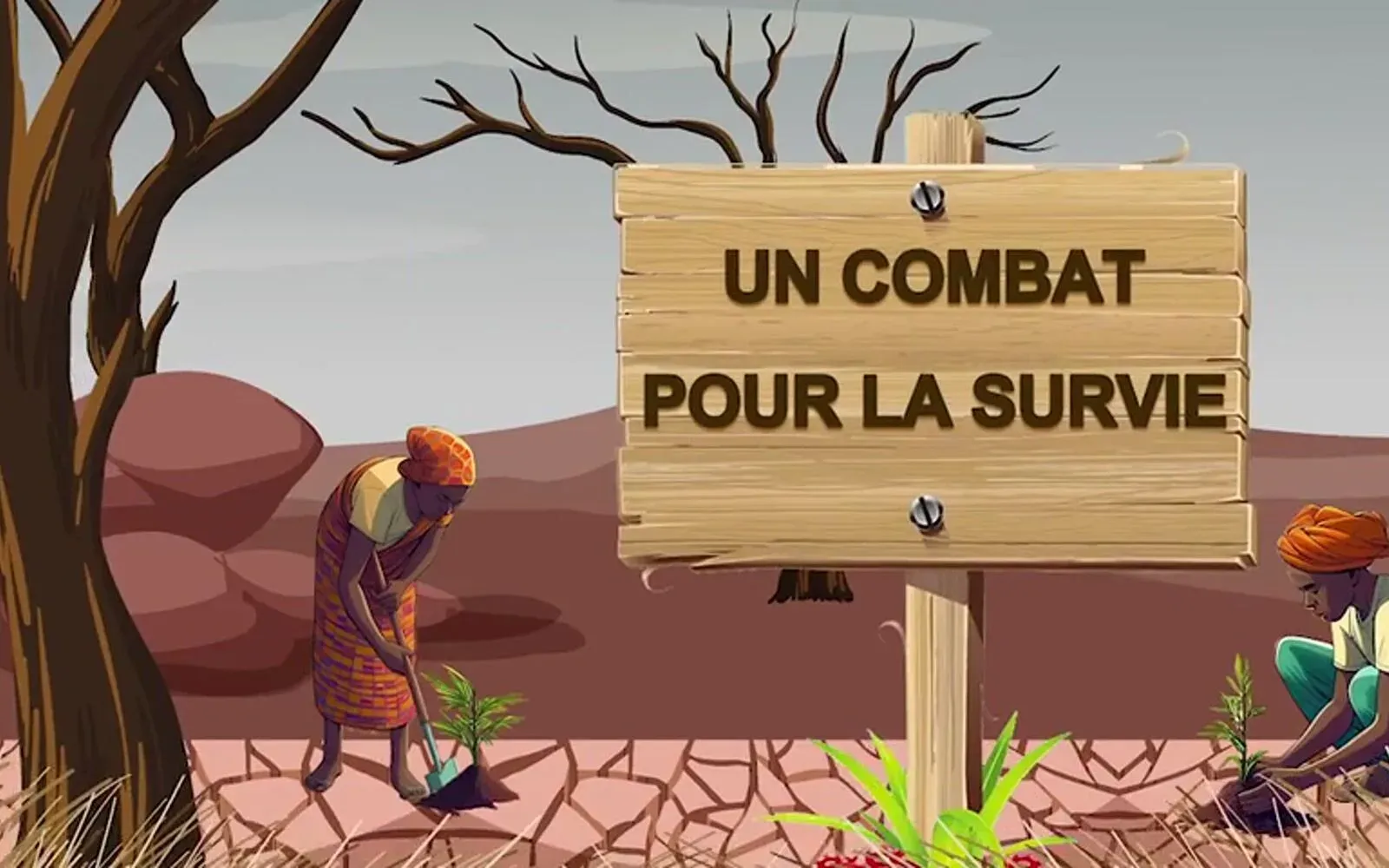
The first script rests on one image and one line — “A fight for survival”, over cracked earth where two people are replanting.
The funders’ branding, built in rather than stuck on
The USAID and partner identities were built into the design from the outset, rather than added as an end card. In an advocacy piece, knowing who is speaking is part of the message: an anonymous film about corruption commits nobody.
Picture and sound together
The sound design was handled alongside the picture rather than after it. Over thirty seconds, music laid on at the end of the edit rescues nothing; it has to carry the build, or the film sags at the twentieth second.
What it changes
These films do not change a law and do not stop a convoy. What they do is more modest and more useful: they give a coalition of NGOs an object it can put in front of an audience, at a border post, or in a room, without having to explain first why the subject concerns them.
That is exactly the role of an advocacy film — not to convince, but to make the conversation possible.
The film
The film, as delivered
Play the video: Transparency International — a fight for survival More work
Also worth a look

ACCKIN
ACCKIN – An accounting firm in thirty seconds
ACCKIN is a 100% virtual chartered accounting firm. We made a thirty-second advertising film: an illustrated app journey on phone and computer, the company-formation offer, then the brand.
Takamoa
Takamoa – Our agency in fifteen seconds
In-house project. Fifteen seconds to introduce the agency: our promise to light up your values, our disciplines, then the monogram building itself and the brand. A reel designed the way we design our clients'.

Takamoa Marketing
Takamoa Marketing – An app in thirty-two seconds
In-house project. The film of Takamoa Marketing, the app we built to run social media: one problem, one platform, six modules in thirty-two seconds, with the app's interface rebuilt for the film and fictional demo data.