Case study
Cacao Link Ordering cocoa from the other side of the world
A bean buyer commits real money to a product they can neither see nor smell. We built the site that shows every lot, publishes its real prices, and brings the order down to a few clicks instead of a negotiation by e-mail.
The context
Cacao Link exports cocoa beans from the Sambirano Valley, in the north-west of Madagascar — one of the most sought-after origins in the world — to chocolate makers, importers and specialty food retailers.
This trade has one feature that decides everything else: the buyer never sees the goods before paying for them. They commit a serious sum to a lot they cannot touch, smell or taste, from another continent and usually another time zone.
Traditionally the gap is closed by the relationship — e-mails, samples, weeks. It works, and it does not scale: every new customer costs exactly as much time as the one before.
What we produced
A site designed so that an order fits into a few clicks.
Navigation that follows the decision, not the catalogue
The interface was built around the real journey: browse the products, compare, choose, order. Categories and sub-categories were organised to cut the time spent searching — a professional buyer knows what they are looking for, and anything that forces them to explore is wasted time.
Real images, real prices
Every product is presented with quality photography and a detailed description, and the actual prices are published.
That last point is the real decision of the project. Plenty of export sites prefer “price on request”, which appears to protect the margin and in practice costs you every buyer unwilling to open a conversation just to learn a rate. Publishing prices means accepting comparison — and it is the condition for being chosen without ever being met.
An order without friction
The funnel was shortened as far as it would go. Selection, basket, confirmation: nothing that does not serve the order, no step that exists for the seller rather than the buyer.
What it changes
The site moves the first conversation. It used to be about the catalogue and the rates; now it is about the lot, the volume and the shipping — that is, about what genuinely deserves a human exchange.
For an exporter selling a rare origin to professionals scattered across the world, that is the difference between a business capped by the number of e-mails you can write, and a business that takes orders while you sleep.
More work
Also worth a look
Hamac
Hamac – Selling outdoor advertising to people who live online
An advertising broker whose inventory sits in places rather than on billboards. We built the site that collects already-qualified quote requests — then, month after month, the content that argues for outdoor advertising where the advertisers actually are: online.

Jeune Patronat de Madagascar
Jeune Patronat de Madagascar – Making a first edition feel like a fixture
The Jeune Patronat de Madagascar was launching its first major entrepreneurs' gathering. In three months Takamoa built the whole thing — identity, content, video, landing page, campaigns — and handed the stage to a host created with artificial intelligence.
Jeune Patronat de Madagascar
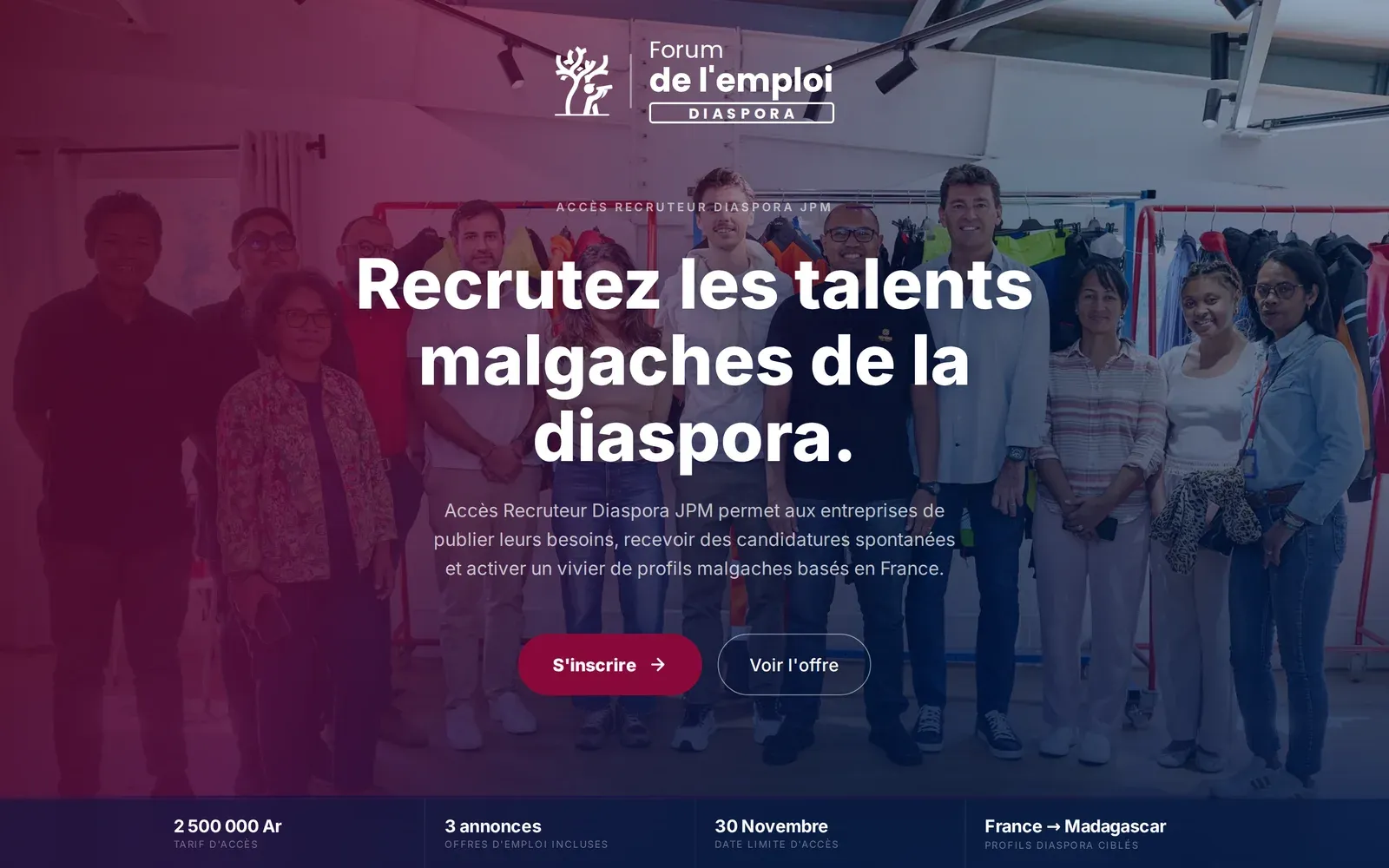
Jeune Patronat de Madagascar – Recruiting at the forum without flying to Paris
The Diaspora job forum brought Malagasy companies and diaspora talent together in Paris for a job-dating event. We built the platform that stretches those two days into five months, and opens them to the companies that could not make the trip.